"If you want your children to be intelligent, read them fairy tales. If you want them to be more intelligent, read them more fairy tales." Albert Einstein
Showing posts with label abuse. Show all posts
28 September 2018
Girl Made of Stars
TW: discussions of rape and childhood sexual assault
Blake, Ashley Herring. Girl Made of Stars. HMH BYR, 2018.
Mara and Owen are twins, and Mara is also close friends with Hannah, Owen's girlfriend. So when Hannah accuses Owen of rape, Mara isn't sure what to do. She doesn't know whom to believe and isn't sure how to react, and it's bringing up memories she had tried to quash.
As a childhood assault survivor, I nearly didn't read this book, not because I didn't think it would be well-written or well handled, but because I wasn't sure if it would be triggering. Mara was assaulted at the end of eighth grade by one of her teachers, and she doesn't tell anyone about it, and then her brother is accused of rape and her family is all rallying around him and her school is rallying around him and no one is standing up for Hannah, and Mara ends up in a sort of tailspin. This is a good book, and a realistic book, in that Owen is never actually brought to trial or formally charged or given any sort of punishment for what he did, and in fact his family doesn't really acknowledge that he did anything wrong.
I am glad for this book's discussion of rape that occurs within a relationship and how difficult it can be for the survivor to be believed since they already had a sexual relationship with the rapist, how it becomes a "he said, she said" situation, etc. etc. I am glad for the Speak-esque plot for Mara, who finally finds the courage to tell others what happened to her. This is a good book, and a necessary book, and the story was handled with the delicateness appropriate for the topic. For survivors, the flashback scenes are in italics, so it would be easy enough to skip over them if you'd like. The assault scene is fairly descriptive and frightening as is appropriate for an eighth grader being assaulted by an adult man.
Recommended for: teens
Red Flags: descriptions of assault, discussion of rape, slut-shaming,
Overall Rating: 5/5 stars
Read-Alikes: Speak, All the Rage, Learning to Breathe
05 September 2018
Alan Cole is Not a Coward
Bell, Eric. Alan Cole is Not a Coward. Katherine Tegen Books, 2017.
Alan's older brother Nathan torments him constantly, so when Nathan comes up with another CvC (Cole versus Cole), Alan has to agree to go along. Each brother has a list of seven tasks and one week in which to complete them. If Alan doesn't agree to do this, Nathan will tell the whole school that Alan has a crush ... on a boy.
To be honest I really, really didn't like this book at the beginning. The brother is just SO cruel, and forcing a middle schooler to compete in this brother vs brother thing or face being outed is just over the top. To make matters worse, Alan and Nathan's father is extremely unkind to his children. He calls Alan "goldfish" because he's forgettable and unimportant and Nathan "pig" because he's messy. He rules over their house with an iron fist, and regardless of what we find out at the end, this makes for a rough beginning of the story.
The middle of the book shows Alan trying to finish his tasks, eventually learning a few things and developing a backbone, and finally we get the *big reveal* where we find out everything that caused this family to be such a mess (which I won't discuss here because spoilers). So there's a reason the father is a cruel heartless dictator and a reason Nathan is following in his footsteps. It does have a happy-adjacent ending, but wow the beginning of this book is rough. I think this is one I would recommend as a "read together" book instead of an independent reading book.
Recommended for: tweens and their grown-ups
Red Flags: bullying, emotional abuse
Overall Rating: 3/5 stars
Read-Alikes: Okay for Now by Gary Schmidt; Better Nate than Ever by Tim Federle
06 July 2018
Sadie
TW: childhood sexual abuse and molestation
Summers, Courtney. Sadie. Wednesday Books, 2018.
Sadie has disappeared. After raising herself and her sister in spite of her mother's drug and alcohol addictions, Sadie hits her breaking point when her mother disappears and her sister is murdered. Sadie is convinced she knows who did it, and she's on her way to find that person and get her revenge.
This book is told in the form of eight episodes of a podcast a la Serial and will likely be fantastic as an audiobook. I will agree with other reviewers that the conclusion was quite obvious to me from the beginning, but that did not diminish my enjoyment of the story itself. Sadie and I have quite a lot in common - older sisters born to single parents, abused by a man who took advantage of our mothers and threatened to abuse our sisters if we told, etc. The infrequent flashbacks that Sadie experiences were not triggering to me but may be to other survivors. I enjoyed this book the way I often enjoy episodes of Criminal Minds: we may already know what the conclusion is, but it's the journey and the explanation of the motivation behind the actions, which made up the bulk of the story, that was so fascinating. This one will definitely be popular with teen patrons.
Recommended for: teens, fans of thrillers or procedural crime shows
Red Flags: drug abuse, alcohol abuse, language, sexual abuse/molestation, murder
Overall Rating: 5/5 stars
Read-Alikes: I Am Still Alive by Kate Alice Marshall, Mind Games by Kiersten White, The Night She Disappeared by April Henry
I received a complimentary copy of this book through Netgalley for the purpose of review.
25 June 2018
What They Don't Know
Maggi, Nicole. What They Don't Know. Sourcebooks Fire, 2018.
Mellie's family is very conservative, so when she discovers that she is pregnant, she isn't sure what she should do. She has always believed that abortion is wrong in all circumstances, but she is certain that she doesn't want to carry this baby, even to give it up for adoption. Lise used to be friends with Mellie before Mellie's family took her out of Girl Scouts. They are still classmates, but their lives couldn't be more different. When Lise hears Mellie crying in the bathroom, she wonders if she can do something to help her childhood friend.
This story is told from both Mellie's and Lise's perspectives, in the form of journal entries they complete for their English class. Mellie's family rings true for the most part, although I have questions about some things, particularly Mellie's reference to the Apocrypha being like an addition to the Bible. From my fundamentalist Christian upbringing, which seems to mirror Mellie's, the Apocrypha was not considered to be Scripture, nor was it anything we ever read or studied. Lise and Mellie also sounded very similar in their journal entries. I was reading a digital ARC, so I am hoping the publisher will use a different typeface or something for each girl, as it was occasionally difficult to remember who was telling the story. The story itself was also a bit didactic and afterschool special-esque at times, which I found grating when the topic itself is so important. Nonetheless, I could see the teens at my library thoroughly enjoying this story and wanting to read and discuss it. Recommended.
Recommended for: teens
Red Flags: discussion of rape, verbal abuse, threats of violence, description of an abortion
Overall Rating: 4/5 stars
Read-Alikes: Speak by Laurie Halse Anderson; Quiver by Julia Watts; Hush by Eishes Chayil
I received a complimentary copy of this book through Edelweiss for the purpose of review.
23 May 2018
Quiver
Watts, Julia. Quiver. Frontlist, 2018.
Libby is the oldest of her family's six children. They live on a remote farm where their mother home schools the children and their father works at his pest control business. They are a Quiverfull family, and thus they believe that the father is the head of the home just as god is the head of the church. Zo just moved next door to Libby. Zo's family is also home schooled, but Zo is genderfluid and her (when pronouns are used for Zo, they are always feminine, so I will continue that practice here) family is vegetarian, feminist, and socialist. Zo's father and mother share equally in parenting duties, neither one promising to "obey" the other one. When Zo and Libby meet, they become fast friends because they are close in age and there's no one else around for miles. But will they be able to overcome their differences and continue their friendship?
Having been raised in a family eerily similar to Libby's and now living much more like Zo, this book was absolutely right up my alley. I appreciated the way the author dealt with Libby's family's beliefs without ridiculing or belittling them. The descriptions of the way the fundamentalist family functioned - from the purity vows of the children to spanking Libby when she disobeyed - definitely rang true. Zo's family also seemed genuine and accurate. I was a bit disappointed that Zo's gender fluidity wasn't given more focus, but this wasn't a story of Zo coming out as gender fluid, and Zo didn't seem to be bothered with people reading her as female. The ending seemed a bit rushed, and while I was glad it was a happy ending, it seemed to be a bit too neatly tied up in a bow to be reality. If this is a stand-alone novel, though, and not the first in a series, it was good to give some closure to the readers. Highly recommended.
Recommended for: teens
Red Flags: Libby's younger sister has some rather "biblical" terms to use in regards to Zo's admission of a past relationship with a girl. Libby's father spanks her with his belt (and requires her to lift her nightgown for this beating). He also storms into the hospital and threatens violence toward several characters.
Overall Rating: 5/5 stars
Read-Alikes: Devoted by Jennifer Mathieu; Evolution, Me, & Other Freaks of Nature by Robin Brande
I received a complimentary copy of this book through Edelweiss for the purpose of review.
04 April 2018
Lighter than My Shadow
Green, Katie. Lighter than My Shadow. Jonathan Cape, 2013.
In this graphic novel memoir, Katie Green tells the story of her lifelong struggle with anorexia and food, as well as her healing and survival. The muted grayscale colors are appropriate for what is a good story, though not a happy story. This book may seem daunting at first due to its size and weight, but it is a quick read and a compelling one. Green brings the reader through her childhood as a picky eater into her teen years when she began her struggle with anorexia, and includes reactions from her friends and family and her continued struggle in her relationship with food.
I appreciated her candor in that she never says she is completely healed. She does, however, find the strength to live each day and to work through each challenge as it comes.
TW: anorexia as well as bingeing (no purging); molestation which, as this is a graphic novel, is a bit graphic in nature
Recommended for: teens and adults
Red Flags: fat-shaming, language, molestation,
Overall Rating: 5/5 stars
28 March 2018
Little Do We Know
Stone, Tamara. Little Do We Know. Disney Hyperion, 2018.
Hannah and Ellory have been best friends and neighbors their entire lives. Now they haven’t spoken for over three months. Hannah’s dad used her college fund to boost the Christian school he founded, and Hannah finds herself falling for the music pastor. Meanwhile, Ellory is cherishing the days until she and her boyfriend head off to separate colleges and is attempting to help her mother plan her wedding. Neither Hannah nor Ellory wants to discuss what happened three months ago.
TW: molestation
SPOILERS AHEAD
It’s impossible to talk about my opinions regarding this book without spoiling the ending; consider yourself warned.
The relationship between Hannah and Ellory rang true for me; also, both of their characters were really well developed. Hannah’s school and church are spot-on for an Evangelical Christian church/school. Ellory’s discomfort at spending time at Hannah’s church also makes sense. I appreciated the discussion of Hannah’s doubts regarding what she believes and whether she believes because it’s true or if she believes because she’s been taught these things her whole life. The church is described accurately without being mocked.
The scene near the end where Ellory and Hannah talk about what happened - Ellory’s stepdad-to-be molested her one day when her mom wasn’t home, and when she told Hannah, Hannah tried to get her parents involved, but a flippant comment from her dad made Ellory feel that she was to blame for what happened. The reveal and consequent dramatic conclusion / Disney-esque ending was a bit much, but probably not over the top for the intended audience. Recommended.
Recommended for: teens
Red Flags: underage drinking, molestation
Overall Rating: 5/5 stars
Read-alikes: Devoted; Evolution, Me, & Other Freaks of Nature; Speak
I received a complimentary copy of this book through Netgalley for the purpose of review.
12 March 2018
Speak: The Graphic Novel
Anderson, Laurie Halse and Emily Carroll. Speak: The Graphic Novel. Farrar Straus Giroux, 2018.
Melinda begins her freshman year a very different person from the one who just finished eighth grade; over the summer she was raped at a party and called the cops. Her classmates don't know about the rape, but they do know about the cops breaking up the party. Melinda is an outcast at the school. She finds herself unmoored without her former friends and is further traumatized by her rapist, who also attends her school. Throughout the school year, Melinda slowly finds her voice and begins to heal.
The novel version of Speak is one of those rare timeless teen books which belongs on every library's shelf. This book is an amazing adaptation of that story. Parts of the book have been updated (references to Instagram, etc.), while the original message of the story is still present. The black and white drawings are appropriate for the serious topic, and the novel manages to portray the ridiculousness of some aspects of high school (such as the constant changing of the school's mascot and the lack of supplies for the art class) while also demonstrating the very real impact the social aspects of school have on a teenager's ability to thrive and learn. Melinda is shown as a very real, developed character who has hidden inside herself; throughout the story we get to watch her unfold and learn to speak again.
I have recommended before that everyone read Speak; I say the same of this graphic novel adaptation.
Recommended for: teens
Red Flags: underage drinking, rape, bullying
Overall Rating: 5/5 stars
02 March 2018
Monday's Not Coming
Jackson, Tiffany. Monday's Not Coming. Katherine Tegen Books, 2018.
Claudia and Monday are best friends and practically inseparable, but one summer when Claudia is away at her grandmother's, Monday doesn't write to her, and Claudia can't find Monday once she returns home, either. No one else seems bothered by Monday's disappearance, but Claudia is determined to find out what happened to her.
*** SPOILERS AHEAD***
This book alternates between "before," chapters before The Big Event, and "after," which are after TBE, and things that are labeled "One year before the before" or "two years before the before," etc. etc. It's extremely confusing to read because some of the chapters are short and the time jumps around so much. The bottom line is that Monday was from an abusive home and her mom beat her and locked her in a closet until she died, then stuffed her body in a freezer, and Claudia was the only one who noticed she was gone because Monday didn't live in a nice part of town and no one was willing to say anything. Claudia has a breakdown after Monday's body is discovered, and she loses about two years of her life as she tries to recover, during which time she often forgets that Monday is gone.
What I Liked: The premise is good and necessary, even if it doesn't make for a nice, happy story.
What I Didn't Like: The time jumps in the chapters were difficult to keep track of since there were so many timelines going on at once. This book is also WAY too long to tell the story it was telling. The 400+ page tale could have been reduced to maybe half that. Claudia doesn't read as 14 (the age she believes she is) or 16 (the age she actually is). This may be due to her trauma, but she still sounds so much younger than she actually is.
Bottom Line: I will probably buy it for the library, but it won't go on my personal shelf.
Recommended for: teens
Red Flags: abuse, domestic violence, murder, bullying, drug and alcohol use, language, homophobic language, ableist language
Overall Rating: 2/5 stars
01 December 2016
Holding Up the Universe
Libby was once called "America's Fattest Teen" and had to be removed from her house via crane because she couldn't fit through the door. That was several years and over 300 pounds ago, and now she's going back to high school. Jack is a stereotypically popular jerk of a guy who cannot remember people's faces and has managed to keep this hidden from those around him. Jack and Libby fall in love.
I agree with others that it's pretty much impossible to believe that Jack has hidden his prosopagnosia from his family, especially since he believes it began due to head trauma when he was young. The bullying and teasing and whatnot is believably typical. Other than that, this does seem to be a story where the two teens have problems just to make their romance more fantastic. Libby is not well-rounded enough, and Jack is too much of a jerk. It's a book where nothing happens and then nothing happens and then insta-love happens. My teens will love it, but I'm not impressed.
Recommended for: teens
Red Flags: bullying, fat shaming, underage alcohol and drug use
Overall Rating: 2/5 stars
Read-Alikes: All the Bright Places, Butter, 45 Pounds
24 November 2016
Still Life with Tornado
Sarah is 16 and she's quitting school. She stops going one day and refuses to go back, using her time instead to wander the city. Then she runs into her 10-year old self and her 24-year old self. The other Sarahs help 16-year old Sarah to face some hard truths about her life.
The chapters in this book alternate between flashbacks to when Sarah's family took a trip to Mexico when she was 10 and now, when Sarah is 16. Sarah's father is physically abusive to her mother and her brother, but Sarah wasn't ready to face that until now. She also needs to deal with a bullying situation at her school as well as what to do with herself now that she is not attending school at all. I liked this book much more than previous A.S. King titles and found it easier to follow. I would recommend it to teens who like sad books or books about kids facing hard things in their lives.
Recommended for: teens
Red Flags: bullying, domestic abuse, language, alcohol use by minors
Overall Rating: 4/5 stars
Read-Alikes: Speak, Girls Like Us, Split
13 July 2016
Afterward
Dylan, an 11-year old boy with autism, is kidnapped, but when he is found only days later, it is discovered that the man who kidnapped Dylan had also kidnapped another boy, who has been living with the kidnapper for years less than an hour from his parents' home. Dylan's and Ethan's families are glad to get them back, especially Caroline, Dylan's older sister. Caroline has helped to care for Dylan since he was very young, and now she wants to know how to help him recover from his trauma. Should she reach out to Ethan to find out about Dylan's captivity? Does she really want to know what went on in that house?
This story is told in alternating chapters, with Ethan and Caroline narrating the first year after Dylan and Ethan's rescue. Ethan's family has the means to send him to an exclusive therapist and bring tutors to the house so he can catch up on his schooling; meanwhile, Dylan's family struggles to make ends meet, and Dylan's parents in particular are not handling his capture and return well at all. Caroline does befriend Ethan, much to Ethan's hovering mother's dismay.
As a childhood rape survivor, I can attest to the accuracy of the scenes between Ethan and his therapist, including the difficulty Ethan has with the drive to the therapist's office, the flashbacks, the counting technique, the memories that are just gone because Ethan's brain is not ready to process them yet. I can sympathize with his frustration at his Swiss cheese-like memory.
This book captures the reader's attention and keeps it; it will be very popular with my teen patrons who are always clamoring for "books about kids who deal with really hard stuff," and it would be an easy recommend to abuse survivors because Ethan's reactions are well-portrayed but there aren't many details about what exactly went on during the years he was gone. Recommended.
Recommended for: teens
Red Flags: both Dylan and Ethan are kidnapped; Ethan struggles with flashbacks, which may be triggering to trauma survivors
Overall Rating: 5/5 stars
Read-Alikes: The Sacred Lies of Minnow Bly, Reality Boy, Eleanor & Park
I received a complimentary copy of this book through Netgalley for the purposes of review.
13 May 2016
The Way I Used to Be
Eden wakes up after a nightmare, but the blood on her sheets and the bruises on her thighs belie the truth: her brother's best friend, the "adopted son" of her family, raped her last night. She is too frightened, to confused, to tell anyone about it in the days and years following the rape. She struggles with redefining herself as a survivor. Will she find the courage to tell the truth and save another person from the same fate?
I really, truly wanted to love this book. I loved Speak, LOVED it, but the sympathy I felt for Miranda isn't there for Eden. Yes, it is true that some rape survivors respond by becoming hyper-sexual and sleeping around, as Eden did, but this book was frustrating in its sameness to a thousand other stories, in its way of glorifying the horrors in Eden's life, not only over a brief period, but for four long years as we watch things continuously spiral downward in her life. Her family doesn't know what's wrong with her; she loses interest in her hobbies; she starts to sleep around; she loses her friends. All these things are believable reactions to a rape, but this story doesn't go anywhere. Eden is a stable flat line throughout the entire book. She doesn't change. She doesn't grow. She doesn't develop. If Exit, Pursued by a Bear tells the fairy-tale version of a rape where everything is wonderful afterward and happens the best way possible, this is the twisted version, where everything happens in the worst way possible and stays that way for the entire book.
I agree with other reviewers who posit that we've read this story before, because we have in countless other books. As an abuse survivor myself, I gravitate toward these stories, hoping that I can add them to my stack to pass along to other survivors to help them find healing and strength. This story is the same as a hundred others, and is not in my "to recommend to survivors" pile. It's much too long for a story where nothing happens and then nothing happens and then later, still nothing happens.
Recommended for: teens, fans of Ellen Hopkins or books "where the main character has LOTS of problems" as my tween patrons say
Red Flags: rape, drug use, alcohol use, language
Overall Rating: 3/5 stars
Read-Alikes: All the Rage, Girls Like Us, Speak, Exit, Pursued by a Bear
27 April 2016
Exit, Pursued by a Bear
As the captain of her cheerleading squad, Hermione has just one goal for the team: break the school's tradition where one person dies in a car accident and one person gets pregnant every year. When she is raped during summer cheerleading camp, however, her priorities must change.
This book tackles the tough question: "Is it always necessary for rape survivors to struggle and suffer and have lots of difficulties coming to terms with life after trauma?" Many books featuring characters who survive an attack focus on that survivor's struggle and eventual healing. This is not that book. Hermione is a strong person and is focused on cheerleading and her friends and her life. After she is raped, she is still a strong person who is focused on cheerleading and her friends and her life. She does not retreat into herself. She does not hide from hard truths. She does not experience multiple panic attacks or flashbacks, and when she does have them, she has a good support system in place to help her out.
I wish I could say this was a typical survivor experience, but I think each situation is unique and that Hermione is blessed in having parents and friends who can support her in the aftermath of the attack. This is not a "the girl is faking strong and will have a break down at the end of the book and ask for more help" story. Hermione has a good life, and even when something completely horrible happens to her, her life is still pretty good.
What I liked: Hermione is a very strong person and she has strong friends. She speaks her mind and gets things done and her friends stand up for her. Her "boyfriend" at the beginning of the book is kind of a jerk, but that's the extent of his plot. Hermione chooses to have an abortion after her rape, and everyone - including the local religious leader - is okay with this decision. She has a best friend who comes out as lesbian, and everyone - again - is okay with this. Hermione's name is an obvious HP reference, and the "I love you" "I know" bit is from Star Wars, which warmed my geeky little heart.
What I didn't like: Hermione's world is almost too perfect, so while I love this story, I don't think it rings true for many rape survivors. It is typical not to be believed in light of disclosing a rape. It is typical to have people question what you were wearing or what you did or whether you deserved it. It is typical to struggle with things like doctor's appointments, the possibility of abortion, flashbacks, panic attacks, etc. Hermione gets to skip all of those things, and while that makes for a nice story, it doesn't provide hope to those who struggle with surviving. But there are other books that fit that bill, and this one does a good job at what it aims to do - tell a story of a calm survival.
Recommended for: teens
Red Flags: Hermione is roofied and raped at camp; she later has an abortion; she has occasional flashbacks and panic attacks which fellow survivors may find triggering
Overall Rating: 4/5 stars
Read-Alikes: Speak, Gabi, a Girl in Pieces, All the Rage, Girls Like Us
22 April 2016
My Life with the Liars
Zylynn has always lived with the Children Inside the Light. She's eagerly anticipating her 13th birthday, less than two weeks away, when she is taken Outside and forced to live with her father and stepmother. She knows she can't trust a word they say - she's been told they are Liars - and she is determined to return to the compound before her very important 13th birthday, when she will go through the Ceremony and become an adult. But her father and stepmother's kindness is wearing down her walls. They let her eat as much as she wants and she gets to wear colors and have her own possessions. Will she be strong enough to return to the Light, or will she miss her Ceremony and live in Darkness forever?
I love stories, real or imagined, about people who escape strict religious cults. This particular book is aimed more at a middle grade audience, and our protagonist is much younger than the typical 16-year old escapee from other books. She's confused because she only knows what she's been taught in the cult, so she does things like sleep with the lights on, hoard extra food under her bed, and refer to her parents by their first names. She doesn't know about wearing clothes with colors, or what an iPad is, or what it feels like to ride in a car. She tries desperately to return to the compound, to the things she finds familiar, but there's a pull in the novelty of things like strawberries, a room of one's own, and love.
I love that this story is told from Zylynn's point of view. We see her confusion and struggle over living in this strange, new world. We see her desperation to return to the compound, and the love and patience of her family. When Zylynn hoards food, her stepmother puts it in containers for her, but leaves it under the bed where she had it, even though it is rotting. No one turns off her light at night while she sleeps because she is used to sleeping under bright lights. I read this book in one sitting, which is something I very rarely do. Recommended.
Recommended for: middle grade, teens, fans of religious cult stories
Red Flags: kids in the cult are neglected and starved, they are punished with what I'll have to call "mild stoning" [yes, with rocks, but little ones],
Overall Rating: 5/5 stars
Read-Alikes: The Giver, Watch the Sky, Devoted, The Sacred Lies of Minnow Bly, A Good Courage
26 February 2016
A Step Toward Falling
Emily and Lucas crossed paths when they both witnessed a classmate being attacked at a football game and chose not to assist her. They are now earning community service hours by assisting at a center for adults with disabilities. Meanwhile, Belinda, who was able to fight off her attacker, is at home, too afraid to return to school. Emily thinks all football players (like Lucas) are dumb jocks, while Lucas is too proud to come down off his society-imposed pedestal to interact with lowly Emily. Somehow the two of them must work together to apologize to Belinda and make things right.
I am glad for another book featuring a protagonist with a disability, and I appreciated the way Belinda stood up for herself and was able to return to school, in spite of her grandmother's objections. I am glad for the punishment Emily and Lucas received and that they were able to learn about a different segment of the population and grow to feel compassion for them. The whole "we're going to put on a play at the last minute and it will totally work and be awesome" idea was ridiculous, but probably exactly the type of thing teens would think would work. I saw the obvious connections between Belinda's obsession with Pride and Prejudice and Emily and Lucas's relationship, and it was an interesting addition. I didn't love this book, but I do like it.
Recommended for: teens
Red Flags: Belinda is attacked and groped at the football game
Overall Rating: 3/5 stars
Read-Alike Recommendations: Girls Like Us, Speak, All the Rage
18 January 2016
I Fired God
Zichterman, Jocelyn. I Fired God: My Life Inside - and Escape From - the Secret World of the Independent Fundamental Baptist Cult. St. Martin's Press, 2013
As a person who also grew up in the IFB, attending camp at the Wilds of the Rockies, at Northland Baptist Bible College (now the defunct Northland International University); spending six years earning two "degrees" from Bob Jones University, and leaving the world of the IFB behind after six additional years teaching at an IFB school, I can attest that Zichterman details accurately the life within the IFB. To be sure, her home life was more extremely abusive than may be typical, but the church politics, the breaking of a child's will, the focus on women staying home to serve their men - all of this is seen throughout various sub-cultures of the overall IFB culture as a whole.
I myself have interacted with many of the people Zichterman mentions in her book and was not remotely surprised at the character abuse she endured upon her escape, along with multiple pleas to return to "the truth that she knew." I myself was chastised for not tithing exactly ten percent of my paycheck, which was easily discoverable at my church since one of the deacons was also the school principal. I, too, was chastised for being female and wanting to think or learn or have opinions. I, too, experience flashbacks to childhood abuse and was told the most important thing was to forgive my abuser and ask for forgiveness for any sin I may have committed while having the flashbacks to being raped as a 6-year old child. I also left the IFB behind, discovered my "degrees" from Bob Jones University were worthless, and was forced to start over again, working multiple jobs while I put myself through an accredited university education so I could get a new position outside of fundamentalism.
This book isn't an easy one to read, and I'm certain it wasn't an easy story for Zichterman to tell. But it is the truth, and it behooves us to remember that there are many of these churches scattered throughout the country where children are growing up uneducated, abused, and virtually trapped because they cannot imagine a way out and have no support system in place should they choose to leave. Recommended
Recommended for: adults, those who wish to learn more about the IFB or Bob Jones University, etc.
Red Flags: lots of descriptions of abuse, language
Overall Rating: 4/5 stars
15 January 2016
The Sacred Lies of Minnow Bly
Minnow Bly is in prison because she brutally beat a man under a bridge, beat him so badly he was hospitalized, even though she has no hands. That's right: Minnow recently escaped a cult where her hands were cut off as a punishment for disobedience. As Minnow adjusts to life away from the cult and in the juvenile detention center, she meets with an FBI agent who is trying to get the whole story of the Kevinian cult, especially the events leading up to the fires that claimed the life of their leader. Minnow knows who killed him, but will she tell?
Wow. This book was a difficult one to read, but I found myself compelled to turn the pages even as I was horrified by what happened to Minnow and the others in the cult. The juxtaposition of Minnow's life of relative freedom within the juvenile detention center and her very controlled existence in the cult is astounding. For the longest time I was sure I had figured out the ending, but I was actually surprised because the person I thought had killed the prophet actually didn't do it. This is a difficult book, but a great one. Recommended.
Recommended for: teens, fans of books with strict religious groups
Red Flags: language, lots of violence (the main character gets her hands amputated with a hatchet, for one thing)
Overall Rating: 5/5 stars
Read-Alike Suggestions: A Good Courage, The Poisonwood Bible, Eden West, Watch the Sky
23 December 2015
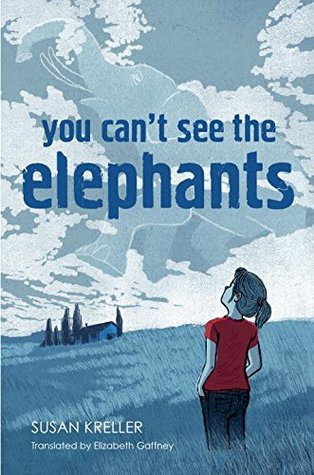
You Can't See the Elephants
Mascha is languishing during her annual visit to her grandparents' small town. She is an outsider and has no one to play with during the summers she spends there. Then she meets two kids who have some strange bruises. She tries to tell, but no one believes her, until she decides to take matters into her own hands.
Child abuse is a very real issue, and I found Julia and Max's family to be completely believable. Of course they were able to put on a front, and of course the sleepy little town chose to ignore it rather than make waves. Mascha definitely made some, ahem, unusual choices regarding how to help Julia and Max, but in the end, she really was the one who helped them. I liked that this book was told from a bystander's point of view, and while it is obvious what is happening with Julie and Max, it isn't graphic.
Recommended for: middle grade, tween
Red Flags: Julie and Max both show signs of abuse, including mentioning that their father threatened to kill their mother if they told anyone
Overall Rating: 5/5 stars
Read-Alikes: Rain Reign, Nightingale's Nest, The War that Saved My Life
19 August 2015
The War that Saved My Life
Bradley, Kimberly. The War that Saved My Life. Dial Books, 2015.
Ada has never left her apartment. Her abusive mother refused to have Ada's clubfoot treated when Ada was an infant, so now Ada crawls about their apartment and cares for her younger brother. With the second world war on the horizon, many parents choose to send their children out of London to keep them safe, and Ada escapes with her brother and ends up living with an older single woman who never wanted children. Ada is safer now than she's ever been, but will she ever learn to trust?
Wow, this was a hard book to read. There will be spoilers in this paragraph, so consider yourself warned. Ada's mother locks Ada in a cupboard to punish her or her brother. I spend the first part of the book wanting to slap the woman for treating her children like that. When she escapes, Ada exhibits all the typical symptoms of a person with PTSD: she gets irrationally angry, has nightmares, and sometimes experiences panic attacks that are only abated when she is wrapped tightly in a blanket. Until she escapes London, Ada has never seen grass or trees, has never been educated, hasn't ever eaten a peach or a Brussels sprout. In the country she learns and grows and recovers and is well-fed. The book has a bit of a sad ending, but it's better than I had initially expected.
I highly recommend this book to fans of WWII historical books as well as those who wish to add more books about differently abled characters to their collections.
Recommended for: middle grade
Red Flags: Ada's mother slaps her and her brother, locks her in a cupboard, and calls her horrible things. There is a mild amount of British cussing involved. Ada herself is violent toward her brother until she learns not to react that way. Survivors of childhood physical abuse and neglect may need to take special care.
Overall Rating: 5/5 stars
Subscribe to:
Posts (Atom)