"If you want your children to be intelligent, read them fairy tales. If you want them to be more intelligent, read them more fairy tales." Albert Einstein

Showing posts with label library programming. Show all posts

05 October 2017

1000 Books Before Kindergarten: A Relaunch

My library was already using 1KBB4K when I started here, but I quickly realized that this was a very underutilized program. It is listed on my monthly statistics, but I can count on one hand the number of times in the past year that someone has asked about it or turned in a reading log, etc. etc. If we're going to do a program, I want us to actually have some involvement, so I decided it was time to relaunch 1KBB4K at my library.

I planned my relaunch for late September, after the school-aged kids were settled in at school and storytime had returned to its non-summer routine. I planned to do this relaunch twice: once during our regularly scheduled morning storytime and once as a special evening event for families who cannot attend our daytime programs.

As part of this relaunch I decided that our materials needed to be gone through as well. Previously our library had used colorful reading logs where each color corresponded to a particular level in the program. We also had a small bin of prizes - mostly temporary tattoos - and no signage or displays relating to this program.

Displays
I created a racetrack display in our meeting room. If a racetrack doesn't suit your fancy, there are dozens of different 1KBB4K display pictures available on the internet. The important thing was to have something up on the wall that the kids could see. For me, this has a double benefit: the display is up so kids can keep track of their progress, and this display happens to be in the same room where we have storytime every week, so kids and caregivers will see this display and be reminded about the program.

Prizes
I admit I was disappointed to discover that we only had temporary tattoos as prizes to give to 0-5 year olds. Many of the kids participating in this program are too young to want or enjoy a temporary tattoo. I understand that the idea is to give them a fun prize they will enjoy, but that won't break the library's budget, but I was able to replace those tattoos with some prizes from the party aisle of my local big box store. I found a variety of things - small sports balls, bracelets, little containers of Play-Dough, etc. I made sure to include items that are good for very young children and are not choking hazards. A box of colorful toys is much more fun to dig through than a box of temporary tattoos.

This is not from my library, but these are what our log sheets looked like.
Logs
Our old reading logs required parents to write out the title of every individual book they read with their children. This means in addition to reading 1,000 books, they had to write 1,000 titles, and all of this on top of what is probably already a very busy schedule. Since I don't actually need to know what books a child has read, I made a new form that consists of 100 flags, and the kids and their caregivers can color in or cross out a flag every time they read a book. Not only does this eliminate the title-writing requirement, but it also allows the child to participate in marking their books on the sheet, which will help build enthusiasm for the program. Our new reading logs also leave a space to write in what number the patrons are working on (0-100, 101-200, etc.), so we can use the exact same log paper for every patron and there is no need for storing multiple copies of multiple sheets. When I can make things easier for the patrons and easier for my staff, everyone wins.

Program
I ran the kickoff program itself much like I would a standard storytime. I read books, sang songs, and recited rhymes with the kids, and in between activities I told the parents about various benefits of reading 1,000 books with their child. At the end of the storytime, I had a craft set out for the kids and a table where parents could sign up for the program. Patrons who signed up received a bag with some small goodies (pencil, bookmark, etc.) as well as information about the program and a list of suggested books to read. Each child attendee was given a raffle ticket as I was able to give away some of the Kohl's Cares plushies and book sets (which our library received as a donation).

Time will tell if this does indeed respark the interest in this particular program.

Does your library use 1,000 Books before Kindergarten? Do you do a different, similar program? Let us know in the comments!

26 September 2017

Storytime: Forts

My final "building" themed storytime for the summer had to do with forts. We read books about forts, then I brought out two giant cardboard boxes that I had available for kids to color on or play in or read in as their own forts.

Opening Rhyme: Open Them, Shut Them
Rhyme: Two Little Blackbirds
Book: Not a Box by Antoinette Portis
Song: "If You're Happy and You Know It"
Book: Harry's Box by Angela McAllister
Rhyme: Dinosaur, Dinosaur, Are You Behind the [Color] Door?
Song: "Head, Shoulders, Knees, and Toes"
Book: The Tree House by Marije Tolman
Closing Rhyme

19 September 2017

Storytime: Boats


Opening Rhyme: Open Them, Shut Them
Rhyme: Two Little Blackbirds
Book: Sail Away by Donald Crews
Song: "If You're Happy and You Know It"
Book: Boats by Byron Barton
Rhyme: Dinosaur, Dinosaur, Are You Behind the [Color] Door?
Song: "Head, Shoulders, Knees, and Toes"
Book: Little Tug by Stephen Savage
Closing Rhyme

Our craft today was actually a science experiment. I gave each child a sheet of aluminum foil as well as a variety of craft supplies: craft sticks, crayons, string, pipe cleaners, straws, etc. They were to construct a boat that would float when we put it in water. For an extra challenge, I had a bag of pennies to use as "passengers" on our boats. If their boat floated, we added passengers to see how many it would hold before it sank.

This is a great project to demonstrate to parents that science learning can be simple and is something they can do in their homes with supplies they probably already have on hand. Kids were encouraged to make multiple versions of their boat as well, and most of them chose to take them home at the end of storytime.

12 September 2017

Storytime: Frogs


Opening Rhyme: Open Them, Shut Them
Rhyme: Two Little Blackbirds
Book: One Frog Sang by Shirley Parenteau
Song: "If You're Happy and You Know It"
Book: Ribbit by Jorey Hurley
Rhyme: Dinosaur, Dinosaur, Are You Behind the [Color] Door?
Song: "Head, Shoulders, Knees, and Toes"
Book: Fabulous Frogs by Martin Jenkins
Closing Rhyme

Craft: We made clothespin frogs. You can find the original file via Google, but basically I took a frog picture, changed it to a coloring page, then put a line down the middle so it could be cut in half. We colored them, cut them out, then glued them to a clothespin. This is a great activity for small motor control for preschoolers!

05 September 2017

Storytime: Houses


With the "Build a Better World" theme this summer, I thought it important to do at least one storytime on building. We read all about houses and completed a house craft that I had used early for a Three Little Pigs storytime.

Opening Rhyme: Open Them, Shut Them
Rhyme: Two Little Blackbirds
Book: Whose House by H.A. Rey
Song: "If You're Happy and You Know It"
Book: The House that's Your Home by Sally Lloyd-Jones
Rhyme: Dinosaur, Dinosaur, Are You Behind the [Color] Door?
Song: "Head, Shoulders, Knees, and Toes"
Book: Building a House by Byron Barton
Closing Rhyme

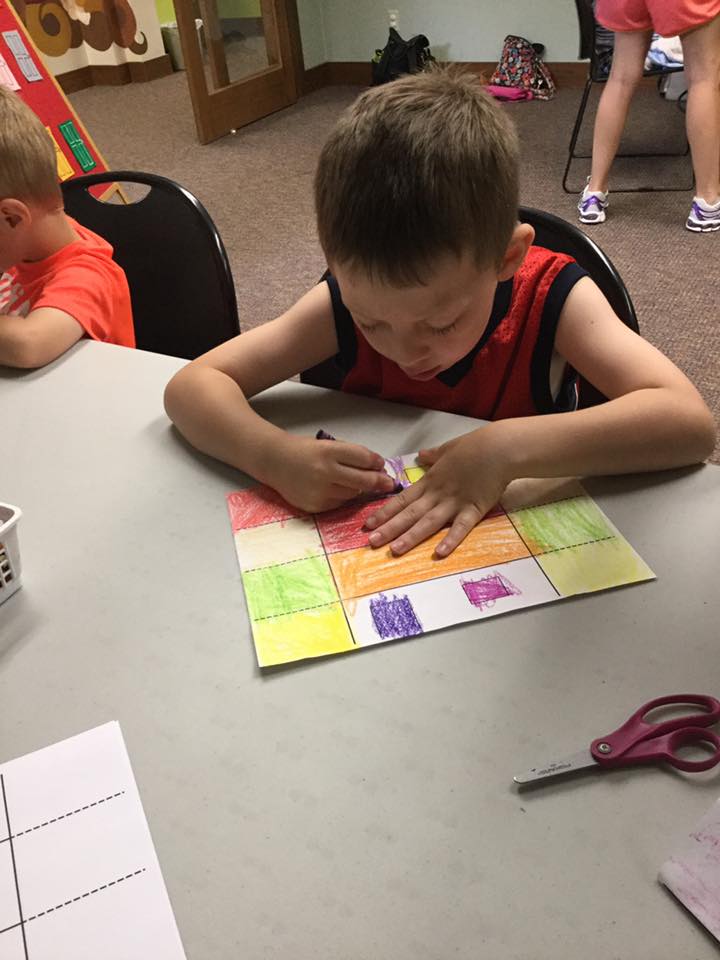
The house we made for storytime was very simple. It's just a piece of paper with lines to divide it in fourths both ways. When kids were done coloring, we cut the outside flaps and taped them together to make the sides of the roof. The best part about this craft is that it is easy for parents and caregivers to replicate when they go home, so they could make an entire village if they want to.

31 August 2017

SRP Recap: Finale

My summer programming was different from my normal school year programming in two ways: I had an outdoor storytime in addition to our regular indoor storytime, and I included one additional program per week - a performer, a movie, an event on the library lawn, etc. etc.

When it came to our finale, I had a few options. With the construction happening right outside the library, it wasn't really feasible to hold the program on the library lawn or in the library itself. However, National Night Out was August 1st this year, so we simply scheduled our finale to occur within the regular National Night Out events our city was already going to hold.

This means there was food, drones to watch, games to play, music, and other items going on - none of which I had to plan myself. I was only responsible for the library's table at this event, and we brought back the teens and their excellent face-painting skills because the teens and the kids both enjoy it and we already have the face paint, brushes, etc.

I would call this event a rousing success, mainly due to the small amount of planning I was responsible for at the very end of a long summer.

29 August 2017

SRP Recap: Photo Scavenger Hunt

This was another teen program I did. I created a list of items the teens needed to take pictures of and set up some basic rules for the program - no driving from place to place, no stepping on other people's property, no causing a ruckus in stores or businesses. Teens had a set amount of time in which to take the pictures, and points were deducted from their group for every minute they were late returning to the library.

Our teens love being with their friends, taking pictures with their phones, and running around town, so this was the perfect combination of those ideas. I will definitely do this program or something similar next summer.

24 August 2017

SRP Recap: Sidewalk Chalk

This was another program that fell into the category of "easy to set up, easy for someone else to run." I brought out our rather generous supply of sidewalk chalk and let kids draw on the library sidewalk. I didn't have any problems with kids drawing anything inappropriate, and the next big rain storm will erase the artwork. Until then, our sidewalks serve as a reminder to all of our patrons that our library is a fun place that welcomes children.

22 August 2017

SRP Recap: Storytime with Dogs


My library, like many others, has a "read to a dog" program that happens once a month. Unfortunately, many people have forgotten or never found out that this exists, so this summer our dog handler and I decided to change that with a special dog-themed storytime. I read a couple of dog books, then we had a local author read her dog picture book, and finally the kids were able to meet Honey, the dog who comes to the library once a month. I told the parents about the program and the kids enjoyed getting to know Honey. We're hoping that this will encourage more caregivers to sign their kids up to read with the dog this fall.

17 August 2017

SRP Recap: Bubbles!


One of my goals in creating programming for this summer was to do things that are simple, cost-effective, and easy to replicate at home. Another goal was to make sure my programs would be doable by staff if I were to be sick on the day of a program.

One week we did bubbles on the library lawn. I bought several gallons of bubble juice and brought out the library's bubble machines, pie plates, yarn, and straws. While the two bubble machines were running, kids could make their own bubble wand by stringing half-straws onto a piece of yarn and then tying the ends together. This loop of yarn became a giant bubble wand with straw handles, and kids dipped it into the pie tins so they could blow big bubbles.

We did run out of bubble juice toward the end, and several kids ran inside to make their own bubble juice using the library's bathroom soap and water, which I didn't mind except for the mess that was left in the bathroom. In the future, I will probably buy some Dawn dish soap and have it available as a backup in case we run out of bubble stuff, and I'll ask my staff to watch the bathroom for kids who are being inventive.

Overall this was a very fun program that worked well for a variety of ages and required very little set up.

15 August 2017

SRP Recap: Teen Food Challenge


Our teens had their regularly scheduled monthly programs this summer, and one of them was a food challenge I'd been wanting to do for a long time.

I set it up similar to a television cooking competition. Each table had several mixing bowls, one knife, and two cutting boards. I set out a variety of other kitchen tools for the groups to share. Since our library doesn't have a full kitchen, I made sure the microwave and toaster oven were plugged in and ready to use.

I purchased a variety of food items for the teens to work with, and divided them into three groups: snack, dinner, and dessert. The teens could use items left over from previous rounds, but couldn't access the new food choices until we got to each round.

As they "cooked" (I use this term generously because one teen used some hot water and one microwaved a piece of S.pam, but other than that no one actually cooked anything), I walked around and asked them about what they were cooking. When I called time, I had them describe their dish, then everyone got a chance to taste it. I managed to survive the night without tasting any of their creations, and I'm sure my stomach is grateful.

If I were to do this program again, I think I would specify what types of things their meals needed to include or given them a goal to aim for like having everyone make a sandwich or a salad. Obviously it would also be nice to have a kitchen to work with, but it's possible to make a pseudo-kitchen out of small appliances.

10 August 2017

SRP Recap: Obstacle Course


One of the most popular programs of last summer was our library obstacle course. We set up an obstacle course on our library lawn using pool noodles, hula hoops, and other common items, and kids really enjoyed running through the obstacle course. One of my young patrons made a point to suggest to me not once but several times that we have another obstacle course this summer.

I set up an obstacle course using the same items as last year. There were two tunnels to crawl through, pool noodles to zig zag around, pool noodles to jump over, hula hoops to jump in, a yarn "laser maze" to crawl through, etc. etc. I mapped out what I was doing beforehand and it took maybe twenty minutes to set up the course. Then kids lined up and went through. Most of them went back and did a second (and third and fourth and tenth) round through the course.

This type of activity is a great one for utilizing volunteers. If I could have borrowed the high school football team, for example, I would have stationed one of them at each event in the course to assist/demonstrate/encourage the kids going through it.

08 August 2017

SRP Recap: Outdoor Storytime


Another change I made to our summer programming this year was to move one of our storytimes outdoors. We have road construction right in front of our library and our town has essentially been split in half. Because of this, I bravely crossed the road construction every week and brought our storytime outdoors. I read the same books I had read in our normal indoor storytime, but I didn't have a craft for the children to complete, Instead, I brought out our bubble machine and the kids chased bubbles over the lawn for five or ten minutes at the end of storytime.

This is another example of a community partnership, in that the local daycare center was able to bring their classes over to attend storytime; they wouldn't have been able to do this had we held storytime at our library. More kids were able to attend storytime, we had it in a different location, and overall the response was very positive. I will definitely repeat this next summer.

03 August 2017

SRP Recap: Butterfly Garden


This summer we were able to partner with our local senior center to create a butterfly garden. We met over at the senior center and read a book about the life cycle of the butterfly, then we headed outside to plant some flowers. Seniors, kids, and caregivers worked together to plant flowers in individual pots, water them, and set them in our new garden area. We are hoping to get a bench for the area later on.

All of the flowers, pots, soil, etc. were donated from local garden centers, so this project did not cost anything for our library or for the senior center. Partnerships like this are a great way to get people who don't visit the library to remember that it is available as a resource for them.


01 August 2017

SRP Recap: Kickoff


Now that our summer reading program is finished, I can finally explain the things I did at my library this summer.

For our kickoff event, we have always had a performer, and we usually hold it on the lawn of the library. In addition to a performer this year, we had these things:

  1. Free ice cream from a local dairy
  2. A photo booth with SRP-related props
  3. Miniature ponies
  4. Face painting with our teens
I ended up being really sick on the day of our kickoff event, so I missed out on all the fun. However, aside from a table for people to sign up for summer reading, the rest of these things were run by outside groups and didn't require much staff involvement. There were enough different things for people to do that they could enjoy themselves, and no one felt like they had to stay on the lawn for the entire event, either. Events that are easy on our staff and enjoyable to our patrons are a win-win in my book.

Looking back at the end of summer, I can't think of anything I would do differently, except for not being sick. 

How was your summer kickoff? Are you making any changes for next year?

18 April 2017

Storytime: Trains


I did a train storytime recently, and not only was it a lot of fun to read books on a very popular topic, but I had the opportunity to provide lots of literacy skills practice during our craft.


Opening Rhyme: Open Them, Shut Them

Rhyme: Two Little Blackbirds

Book: Trains by Patricia Hubbell

Song: "If You're Happy and You Know It"

Book: Train Man by Andrea Zimmerman

Rhyme/Game: Dinosaur, Dinosaur, are you behind the [color] door?

Song: "Head, Shoulders, Knees, and Toes"

Book: Freight Train by Donald Crews

Closing Rhyme


Craft: For our craft, we made name trains. I found a train coloring page online and copied the engine picture, then shrank it to a quarter sheet. Each child colored an engine, cut it out, and glued it to their paper. Then we added square "cars" behind the engine with our name letters on them. This was a great opportunity for my young patrons to practice cutting, pasting, and writing, and they all pointed to the letters in their names and told me what they were. I love being able to demonstrate this type of activity for the parents and caregivers, as it models a literacy project they can do in their own home as well.


14 March 2017

Pokemon Readers' Advisory, Part 2


About a month ago, I wrote a post about the Pokemon bookmarks I had started using in my library. These bookmarks were created as a way to keep kids coming in the library and to teach them about using our catalog to find the books they might like to read.

During the month of February, fifty bookmarks were completed and turned in to me. With each bookmark, I read the child's suggestions and then awarded them an envelope of Pokemon cards. We switched out the character on the bookmark every time we ran out of bookmarks. I never once mentioned these bookmarks at Pokemon Club or in front of any group of kids. They learned about them mostly via word of mouth, the signage on our circulation desk, or if they were here alone and bored and came to visit me in my office.

It is March 10 as I am writing this. I have 24 completed bookmarks on my desk from this month alone. We flew through the initial set of eight bookmarks I had made, so I created an additional eight bookmarks. I would definitely call this program a success, and I plan to keep it going as long as the kids show interest. I have, however, made a couple of tweaks to the program in order to make things run more smoothly:

1. Inform the Staff. I made sure my staff knew that the bookmarks existed, sure, but I didn't think to warn them about the number of kids who would be asking about them or who may need assistance locating books to put on their bookmarks. Many of my staff jumped right in and helped out where needed, even giving kids one-on-one lessons on how to use our library's catalog. I enjoyed watching this because it gave our kids a positive interaction with an adult and also empowered them to look up other books later on.

2. Adjust on Programming Days. Yesterday was our monthly LEGO Club. A few of the kids from LEGO club knew about the bookmarks and filled them out before coming to club. Then they walked in with Pokemon cards in their hands, and many of the others wanted to know where they got them. This led to kids leaving LEGO club to fill out a bookmark, which isn't really something I minded. However, we finished up one character's bookmark, which my staff then replaced with a new one. The rule for the bookmarks is that you can only complete each character once, so when some of the kids saw a new bookmark set out, they completed that one, too, and received a second set of cards for the day.

There were a couple of ways I could have handled this. I could change the rule to one bookmark per day. I could instruct the staff not to set out a second character on program afternoons. Because it had already happened by the time I noticed yesterday, I told the staff not to put out a third character, even if the second bookmark ran out, and came up with a solution for the next time: On days when I have programming after school, we will set out a large quantity (25 or more) of one character. This way, all children who want to participate can do so, but no one can complete the bookmark twice in a day. It would have been very easy yesterday to get ten children to complete all the bookmarks ad infinitim, and they would have happily cleaned me out of my stock of Pokemon cards.

This program has led to many great one-on-one conversations with my young patrons about Pokemon and books, two things I will happily chat about any day.


28 February 2017

Teen Program: Anti-Valentine's Day Party

The teens at my library have a tradition of holding an Anti-Valentine's Day party every year. As this was my first February with them, I had to ask the teens and scour the previous librarian's files to see if I could find out what exactly they'd done in the past at these events. I have discovered that I generally plan about twice as many things as we have time to do, so for this program I intentionally simplified things, which ended up working out really well.


Snacks: Traditionally, the teens have eaten "stinky" snacks, things that would make one's breath smell bad. I brought in shrimp-flavored chips (available at many Asian markets) and Fritos along with onion dip to fill in that category. I like to serve something sweet, too, and the teens LOVE candy, so we had gummy worms (leftover from another program) and these poop emoji fudge things, which were almost as much fun to make as it was to watch the teens eat them. We also had oranges, as one of my teens has specifically requested that we have fruit or a similar healthy item available, which I think is a fantastic idea.


Activities: I had a ton of ideas for activities, but I settled on two: one game and one craft. For the game, we played "heartbreaker," which is where each teen inflates a red balloon and attaches it to their ankle with a length of yarn. The teens then run around the room attempting to pop everyone else's balloon while protecting their own. The teens really enjoyed this particular game, both because of the competition and because popping balloons is, apparently, hilarious. I liked this game because the rules are simple and there wasn't anything to purchase in advance; the library already had balloons and yarn available.


Our second activity was stuffed animal taxidermy. I bought a bunch of plush animals at the dollar store: bears, gorillas, bugs (I think they were "love bugs"), puppies, etc. The teens cut off the heads and hot glued them to some wooden plaques we already had. This then degenerated (as I expected) into making franken-toys. The teens took the leftover bits and used our sewing supplies to make new creatures out of the leftovers. The creepiest one by far was wearing what the teen called "the skin of its enemies;" i.e., the leftover unstuffed body of another stuffed animal.


The teens had a good time, the clean up wasn't too difficult, and overall I would consider this program to be a success. If I were to do it again, I would probably eliminate the onion dip (since no one ate it) and make sure there were extra plushies and sewing supplies out, since the teens enjoyed creating their franken-animals.

07 February 2017

Pokemon Readers' Advisory


I run a Pokemon Club at my library as part of a regular series of after school programs. The kids who come to my club are always very excited to be here, and they often stop by and talk about Pokemon or ask me when we'll meet again, even if Pokemon Club is weeks away. I am glad to have such a large group of kids who come to the library on a regular basis, but I wanted to find a way to keep them engaged with the library between meetings. I know these kids love their Pokemon and they love talking about them, too. So I wondered, would it be possible to do readers' advisory for a particular Pokemon?

I created bookmarks with a Pokemon on one side and a list of 3-4 books I think that Pokemon would like to read. I did this based on my (admittedly limited) knowledge of the different characters and their personalities. I made sure all the books I listed were part of my library's collection, and I added the call numbers after each one in case a child would want to find them on the shelf.


For the back side of the bookmark, I used a picture of that Pokemon's evolution and left a blank area for the patron to suggest books for that Pokemon to read. I set out one set of these bookmarks (ten copies of the exact same one, so that one child didn't stop by and try to "collect 'em all" by grabbing the set), along with a sign explaining what to do. Children were free to pick up a bookmark, choose books for that Pokemon to read, and write down the titles on the bookmark. Once completed, they brought it to me and received free Pokemon cards.


Our library has amassed a large collection of slightly random, mostly common Pokemon cards. I will admit that more than a few of these were from my own collection, as I thought it important to learn how to play the card game before we started our Pokemon club. I want the library to have a small collection of cards that I or a volunteer can use during club meetings so that kids who are intimidated by trading with other kids, but who still want to trade, can do so with me. However, in an average batch of Pokemon cards, there will be several duplicates. I compiled all the duplicates into several stacks by type and dealt them into piles so that each stack contained, for example, two fire Pokemon, two water Pokemon, etc. Then I put each stack in an envelope. Kids who finish the Pokemon bookmark receive one envelope of cards, which gives them an incentive to participate and also rids the library of all of its extra cards. None of the kids are receiving super-valuable cards, but the cards are still good for trading or playing the game.


I haven't even announced this passive program to my Pokemon club kids yet as we haven't had a meeting since I made the bookmarks, but in just the first 24 hours of the bookmarks being out, I already had six kids stop by my office to receive their cards. They informed me that it was easy to look up books on the computer and add them to their list of suggestions; I'm glad that they have a skill - looking in the library's catalog to find a book - that many of my patrons lack.

I was hesitant at first to try this program, as it seemed a bit labor-intensive, but it took less than ten minutes to create the envelopes of cards, and the bookmarks took less than an hour to create and not very much time to print, either. I only have eight different bookmarks made so far; if this program is as successful as I hope it will be, I will add more later on. If it fizzles out and is no longer interesting, then I won't bother creating more bookmarks.


You can access the bookmarks here. Enjoy!

UPDATE: The second part of this article can be found here.

02 February 2017

Felt Boards: Not Just for Littles


I have recently acquired a tabletop felt board for use in my children's department. The opposite side is a white board / magnet board and holds a collection of alphabet letters that kids and caregivers can play with. At first, I only put familiar stories on our felt board using premade sets, things like Goldilocks and the Three Bears or The Gingerbread Man. However, we get a fairly large crowd of school-age kids in my library afterschool, and although they will happily play with these familiar stories, there are other things they like more. Thus my Pokemon felties were born.

Koffing, Oddish, Psyduck, Gastly
Squirtle, Eevee, Polywag, Pikachu
Slowpoke, Jigglypuff, Togepi
Eggxecute, Charmander, Bulbasaur

I printed out pictures from the internet and traced them on the felt to create each character. Some characters received extra felt layers depending on their coloring. I used puff paint for the outlines and for some of the details.


Already I have noticed more school aged kids gathering around the felt board and discussing Pokemon. I will likely switch this board out for something more small-kid-friendly later on, but it's fun to have something for the bigger kids once in a while.