"If you want your children to be intelligent, read them fairy tales. If you want them to be more intelligent, read them more fairy tales." Albert Einstein

10 October 2014

New Beginnings

This is not me, but I am SO jealous of the blue hair.

Today I start my brand-new job as a children's librarian with a nearby urban public library. I have been vying for a "real librarian" position since I graduated from library school. Unfortunately, I got caught in one of those "we want you to have library experience so we can hire you for a job where you'll get library experience" cycles and things just didn't work out.  I felt lucky to find my position as a library/media technician (LMT) at a local public school, but that job didn't require a college degree (at least, according to the district it didn't) and it didn't pay very well.  I loved - LOVED - the kids I was working with and the staff I worked with, and I was able to do some incredible things in that library, but my school bills aren't getting any smaller, and I've grown tired of working multiple jobs just to pay the bills.  Four years working 2-3 jobs is a bit much.

I've continued applying for full-time, salaried, actual librarian positions while I worked at my school library, and I didn't have any success, really, until recently. I'm not sure what changed, but this summer I had a couple of panel interviews and phone interviews and finally I was in line for a real job.  I kept working at my school library job, and on International Talk Like a Pirate Day (which falls in the same week as my birthday), I was offered a new position.  I am very excited about starting my new position today and being able to work in the field and with the group for which I trained (and for which I put myself in debt to Sallie Mae). This new job is a definite step up for me.

My blog will likely be on hiatus for a few weeks while I adjust to my new position. I am excited about the programs I will be able to share with you, as well as the countless numbers of stories of all the crazy things that will happen with my new kiddos. 

08 October 2014

Tristant and Elijah


Lavoie, Jennifer. Tristant and Elijah. Bold Strokes Books. 2014. $11.95. 207p. SC 978162390751.

Tristant is an out and proud teen with a very supportive family. He has a crush on Elijah, whom Tristant thinks is straight but is actually deeply closeted. Together, Tristant and Elijah discover a letter written by Tristant’s great uncle, who was a gay man living in the early 1900s when it was much more dangerous to be LGBT. As Tristant and Elijah work together to unravel the mystery of Tristant’s uncle, their relationship with each other begins to bloom as well.

This novel is an interesting combination of a character-driven romantic story and a plot-driven historical mystery. The reader learns as much about the Tristant’s uncle as they do about the two main characters. Tristant and Elijah’s relationship develops throughout the story, but an absence of explicit details makes this story an ideal match for young adults and even tween readers who are ready for more mature books without graphic content. The historic information makes this book an easy pair for David Levithan’s Two Boys Kissing. A conversational writing style and character-driven story makes this novel an easy recommend for fans of romance literature, especially boys who may want a romantic story without a female main character. While the lack of friction or difficulties in Tristant and Elijah’s lives may not ring true for most LGBT teens, the presence of a character who is confident in his orientation will be a source of encouragement. Recommended for public and school libraries.

06 October 2014

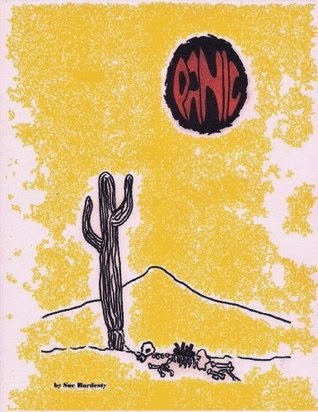
Panic


Hardesty, Sue. Panic. TRP Cookbooks. 2013. $11.25. 164p. SC 9780979270161.

Three very different teenagers travel together into the desert to find Indian artifacts to sell. When their truck breaks down, they must struggle to survive against the dangers of the desert: heat, snakes, lack of water, and panic. Will the trio make it out of the desert alive, or will they succumb to the deadliest factor of all, panic?

With teens as main characters and a survival plot, this book would seem to be an easy sell to a young adult audience. The plot-driven survival story and the trio of very different characters would certainly appeal to teens were the story written in a more compelling style. The simple language of the story and the characters causes the story to feel like an elementary school “first chapter” book, and the sketches and drawings throughout contribute to this juvenile appearance. While weaker young adult readers could definitely benefit from a story written on a lower level, the writing style in this book will not compel them to finish the final page, and the characters will not convince a young adult reader that the author has spent any time around teens.

This book will not appeal to the average young adult, and even strong readers may experience difficulty in finding motivation to finish the story. With further editing and an updated, more contemporary cover, this story could appeal to teens who enjoy survival stories. Librarians looking to add more books containing LGBT characters to their collection should instead consider the works of Kristen Cashore or Malinda Lo.

03 October 2014

Book Talks

Aside from the dated clothing, my library actually looks a lot like this after a book talk.

As a middle school librarian, I have a very small amount of time with each class, and unfortunately I don't see some classes more than two or three times the entire school year.  As such, I try to maximize the time I do have with them.  We do not have a computer lab where I can teach them research skills, so I spend more of my time talking about books.  And let's be honest: middle school is the time when kids stop reading.  They don't have time for it anymore, teachers don't prioritize it, and it stops being cool to be the kid with the newest book.  I can't transform all of our English/Language Arts classrooms into bastions of free reading, but I can do my best to entice students while they're in the library.

When classes do visit the library, I give them a couple of very brief book talks and then let them search for books to check out. Rather than centering my book talks around a theme, I try to find a variety of books.  I have many students who are "onlys": that is, they will only read books written in verse, or only read books with a sportsball on the front, or only read books that are part of a dystopian series. Because of this, I always try to book talk at least two brand-new books, at least two books that have multiple copies in the library, at least one book that's the first in a series, and for all of these I try to choose at least three genres so the kids aren't hearing about only science fiction, or romance, or mystery, etc.   I also try to make sure I only book talk books I've read, which means I have to read from a wide variety of genres and keep current on the books I know about, too.

For example, I might talk about Roland Smith's Peak by saying, "The main character's name is Peak, and he gets in trouble for climbing up the outside of skyscrapers.  The adults decide to send him away for a while so no other kids try to mimic him and climb buildings, too, so he's sent to live with his dad.  But instead of grounding him or taking away his cell phone, his dad takes Peak on a trip to scale Mount Everest, hoping that Peak will become the youngest person to ever reach the summit."   Yes, my students could possibly get that much information from reading the back of the book, but many of them won't be bothered to do so.  They will, however, pick up this book and check it out.

When I finish my book talks, I always put the books I've discussed on a book cart so students can look at them. Sometimes I sneak read-alikes into the cart, books they might also like but that I didn't have time to discuss with them.  When I put Peak on the cart, I added a copy of The White Darkness and a copy of No Summit Out of Sight, and every copy of those three books is currently checked out.

Book talking books to the kids has a few added benefits.  First, the kids learn that I love books and love to talk about them.  This means they are always - and I do mean always - coming up to me and asking what a book is about or telling me about a book they've read or asking for recommendations. Not only that, but giving a book talk and then allowing students to wander and check out books sets the expectation that everyone should be able to find something to read, even if it isn't a 400+ page fantasy tome. I get more kids to check out books when I can show them the wide variety of reading options that are available to them, and book talks are a good way for me to do that.

01 October 2014

Rumble


Hopkins, Ellen. Rumble. Margaret K. McElderry Books, 2014.

Matthew doesn't believe in god.  He hasn't since his brother committed suicide after incessant bullying by his classmates. Matthew's girlfriend is very religious, and Matthew is dealing with the overwhelming loss of his brother as well as the flak he is getting from his teachers and parents because of his vehement insistence that no god could possibly have created such a terrible world.

This book, like much of Hopkins's work, runs the gamut of difficult issues.  We have anti-gay bullying, a kid who is angry at everyone and making everyone wonder if he will bring a gun or worse to school, a girlfriend who has let her religious beliefs blind her to what is going on around her, etc. This is not an easy book to read, but books "about kids with real problems" are very popular in my school library, so as long as they are relatively free of red flags, I try to get as many of them as I can. I would describe this story as "messy," but the lives of my students are also messy, so that isn't necessarily a bad thing.

Recommended for: older teens, fans of novels in verse
Red Flags: language, discussion of suicide and school violence
Overall Rating: 4/5 stars